
What Neurodivergent Culinary Workers Teach Us About Behaviour and Belonging
- drbobcarey
- Apr 11
- 5 min read
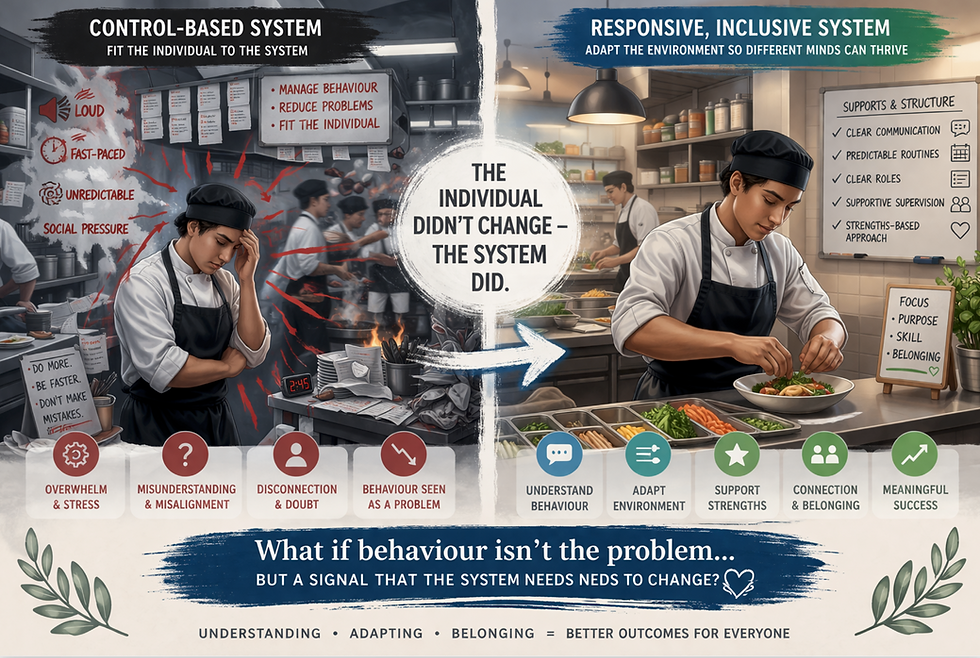
There are moments, as a psychologist, when something you read simply resonates at a deeper level—not because it is new, but because it so clearly reflects what you have long understood to be true. That was my experience reading the recent New York Times article on how neurodivergent individuals are finding meaningful and rewarding careers working within inclusive restaurant environments. The New York Times piece (April 5, 2026) explores a growing movement within the restaurant industry to intentionally include—and in some cases center—individuals on the autism spectrum in culinary roles. It highlights how restaurant kitchens, often seen as chaotic and high-pressure, can actually be well-suited environments for some autistic individuals because of their structure, repetition, clear roles, and sensory predictability when properly supported. The article profiles chefs, restaurateurs, and programs that are creating pathways into culinary work for neurodivergent individuals. These initiatives move beyond token “inclusion” and instead emphasize meaningful employment, skill development, and dignity. In many cases, neurodivergent employees demonstrate strengths such as attention to detail, consistency, focus, and deep engagement with tasks—qualities that are highly valued in professional kitchens. At the same time, the article does not romanticize the situation. It acknowledges that kitchens can also be overwhelming—loud, fast-paced, and socially complex—and that success depends heavily on how the environment is structured. Programs that succeed tend to adapt the system: offering clear communication, predictable routines, supportive supervision, and roles tailored to individual strengths.
A key theme throughout the article is a shift in perspective—from trying to “fit” neurodivergent individuals into traditional workplaces, to redesigning workplaces so that different kinds of minds can thrive. The broader message is one of rethinking inclusion, valuing neurodiversity, and recognizing that capability often emerges when environments are responsive rather than rigid.
What struck me most was not just the compelling stories of individuals finding meaningful work in professional kitchens, but how naturally those stories aligned with the central ideas I explore in What if it’s not just the Behaviour?. At its core, the article is not really about restaurants; it is about how we understand behaviour, and more importantly, how often we misunderstand it.
For many years, the dominant approach to behaviour—particularly behaviour that is seen as disruptive or challenging—has been rooted in control. We have tended to focus on stopping behaviours, managing them, or reducing them, often without fully asking why they are occurring in the first place. Yet the article gently but powerfully shifts that perspective. It illustrates what can happen when we stop trying to force individuals to fit into rigid systems and instead begin shaping environments that allow individuals to function at their best.
This idea sits at the heart of the Positive Systems Approach. Behaviour is not random, and it is rarely meaningless. It is communication, shaped by a complex interaction of internal and external factors. When we view behaviour through this lens, the question changes. Instead of asking how to eliminate a behaviour, we begin to ask what the behaviour is telling us, and what aspects of the environment might be contributing to it .
What is so striking in the article is how characteristics often framed as deficits in neurodivergent individuals are revealed as strengths within the right context. Attention to detail, a preference for routine, and the ability to sustain deep focus are not liabilities in a well-structured kitchen; they are assets. The individuals themselves have not changed. What has changed is the environment—the expectations, the supports, and the way their abilities are understood and utilized.
This is a powerful illustration of a systems-based perspective. When we adjust the system, we often see meaningful changes in behaviour without directly targeting the behaviour at all. In my work, I often emphasize the importance of moving from control to connection, from reacting in the moment to understanding the broader context . The restaurants highlighted in the article embody this shift. They are not focused on making individuals conform; they are focused on creating conditions in which those individuals can succeed.
Another important thread running through both the article and my work is the concept of function. Behaviour serves a purpose, even when it appears counterproductive on the surface. When someone becomes overwhelmed, withdraws, or resists demands, those behaviours are often adaptive responses to environments that feel unpredictable, overstimulating, or misaligned with their needs. What the chefs and programs in the article demonstrate is that when those environmental pressures are reduced—when communication is clear, routines are predictable, and expectations are thoughtfully structured—the need for those behaviours often diminishes.
This is not about ignoring behaviour or lowering expectations. It is about recognizing that lasting change does not come from suppression, but from understanding. When we meet the underlying needs more effectively, behaviour naturally shifts because it no longer serves the same function.
There is also a deeply human element to these stories that cannot be overlooked. Many of the individuals described had previously experienced exclusion or environments where they were misunderstood. This is something I see frequently in families as well—children who come to believe that they are somehow “too difficult” or “not capable,” when in reality they have simply not yet been placed in an environment that allows them to thrive. When that alignment finally occurs, the change can be profound. Confidence grows, skills emerge, and a sense of belonging begins to take hold.
This reflects what I describe in the book as the importance of system factors—consistency, clarity, emotional safety, and supportive relationships . When these elements are in place, behaviour becomes more regulated not because it is being controlled, but because the individual feels secure and supported within the system.
What is particularly encouraging is that this article signals a broader shift in how we think about human behaviour. There is a growing recognition that the question is not simply “What is wrong with this person?” but rather “What does this person need in order to succeed?” and, just as importantly, “What in the system needs to change to make that possible?”
For parents, this perspective is especially important. Every family operates as a system, and the same principles apply at home. When a child is struggling—whether through outbursts, withdrawal, or ongoing conflict—it is often an indication that something within the system is not working for them. This does not mean that parents are at fault, but it does invite a broader and more compassionate inquiry. Are expectations clear and consistent? Is the environment predictable? Are we teaching the skills our children need, or primarily reacting to the behaviours we find challenging?
These are not simple questions, but they are essential ones. The success seen in the kitchens described in the article is not the result of a single technique or intervention. It is the result of a fundamental shift in perspective—a willingness to understand behaviour within its full context and to adapt the system accordingly.
This is ultimately the message at the heart of What if it’s not just the Behaviour?. And it is both validating and hopeful to see that message reflected so clearly in the real world. Because it reminds us that people do not need to be changed in order to succeed. They need to be understood. And when we take the time to get the system right, we often find that behaviour begins to change in ways that feel natural, sustainable, and deeply human.


Comments