
Diet and nutrition linked to children’s emotional wellbeing
When parents come in for a consult about their child's emotional wellbeing, the conversations typically focus on the factors most people naturally think about. They talk about family relationships, friendships, school experiences, learning challenges, anxiety, stress, behaviour, and self-esteem. Occasionally they discuss sleep, exercise, or the impact of technology. What rarely comes up, at least initially, is nutrition. Yet nutrition is becoming an increasingly important part of the conversation surrounding children's mental health.
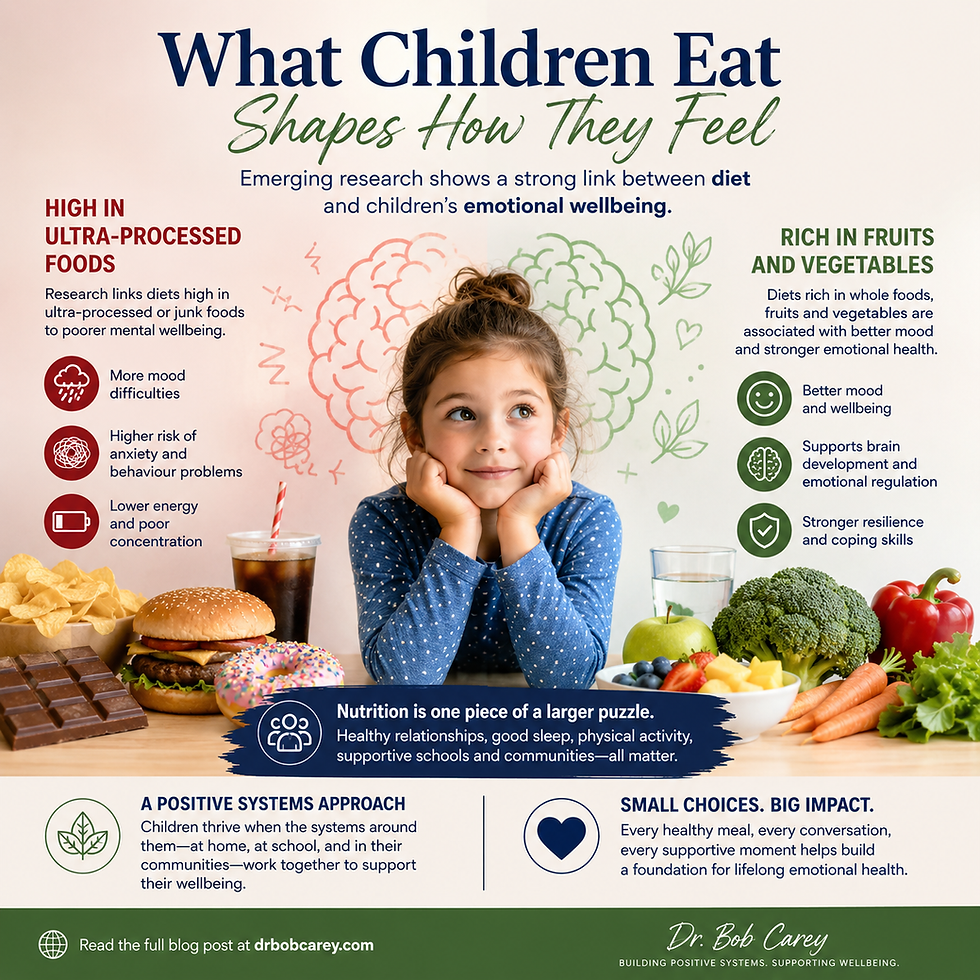
A study published in March 2026 adds to a growing body of research suggesting that the foods children eat may influence not only their physical health but also their emotional wellbeing. Researchers found that diets high in ultra-processed foods were associated with poorer mental wellbeing, while diets that included higher amounts of fruits and vegetables were linked to more positive mood and better psychological health. Although these findings do not establish that diet directly causes emotional difficulties, they contribute to an emerging understanding that nutrition may play a meaningful role in how children think, feel, and function.
This area of research is particularly interesting to me because it challenges the traditional tendency to separate physical health from mental health. In reality, the two are deeply interconnected. The brain is part of the body, and like every other organ, it depends upon a steady supply of nutrients to develop and function effectively. Throughout childhood and adolescence, the brain undergoes remarkable growth and change. Neural pathways are being formed and strengthened, emotional regulation systems are maturing, and the foundations of attention, problem-solving, and self-control are gradually taking shape. It is therefore reasonable to ask whether the quality of the fuel being provided to a developing brain might influence these processes.
Researchers in the field of nutritional psychiatry increasingly believe that it does. Nutrients obtained through food contribute to a range of biological processes that support healthy brain functioning. At the same time, diets that are heavily reliant on highly processed foods have been associated with inflammation, blood sugar instability, and alterations in gut health, all of which may have implications for mood and emotional regulation. While much remains to be learned about these relationships, the evidence continues to move in a consistent direction: what children eat appears to matter for their psychological wellbeing as well as their physical health.
As a psychologist, however, it is important to approach these findings thoughtfully. Human behaviour is rarely explained by a single factor, and mental health is almost always shaped by the interaction of multiple influences. A child's emotional wellbeing is affected by relationships, temperament, genetics, school experiences, sleep, physical activity, life stressors, and countless other variables. Nutrition should not be viewed as a simple explanation for emotional difficulties, nor should dietary changes be seen as a cure for complex mental health concerns. Instead, nutrition is best understood as one part of a larger system.
This perspective aligns closely with the Positive Systems Approach that guides much of my thinking about children and families. When a child is struggling, it is often tempting to search for a single cause or a single solution. In practice, however, children develop within interconnected systems that continuously influence one another. Difficulties in one area can create challenges elsewhere, while strengths in one area can provide support across multiple domains of functioning. Sleep affects emotional regulation. Emotional wellbeing affects motivation and behaviour. School experiences influence self-esteem. Family relationships shape resilience. Nutrition interacts with all of these factors in ways that researchers are only beginning to fully understand. From this perspective, the significance of studies examining diet and mental health is not that they provide a new explanation for every emotional struggle. Rather, they remind us that children's wellbeing is influenced by a wide range of everyday experiences and habits, many of which may seem ordinary but collectively have a profound impact over time.
The findings also encourage us to think beyond individual children and families. Food choices do not occur in a vacuum. They are shaped by busy schedules, financial pressures, food availability, cultural practices, marketing influences, school environments, and community resources. When we discuss the relationship between nutrition and mental health, it is important to recognize the broader systems that either support or hinder healthy eating. Families are often making the best decisions they can within the circumstances they face, and those circumstances deserve consideration when we think about promoting children's wellbeing.
For parents, the practical message is not that every meal must be perfect or that occasional treats are somehow harmful. Rather, the research suggests that creating opportunities for children to consume a variety of nutritious foods on a consistent basis may be one meaningful way of supporting their overall development. Like many aspects of parenting, the goal is not perfection but balance and consistency over time.
What I find most compelling about this research is that it reinforces a broader principle that has emerged repeatedly throughout psychology: children's emotional wellbeing is shaped by the cumulative influence of many small factors rather than a single defining event. Healthy relationships, supportive schools, adequate sleep, opportunities for physical activity, effective coping skills, and good nutrition all contribute to a foundation that helps children navigate life's challenges. When multiple systems are functioning well, children are often better equipped to manage stress, regulate emotions, and recover from setbacks.
As our understanding of child development continues to evolve, nutrition is likely to become an increasingly important component of discussions about mental health. It will never be the whole story, but it appears to be a meaningful part of it. For parents, educators, and professionals alike, this serves as another reminder that children's wellbeing is influenced by the environments and systems that surround them every day, including something as fundamental as the food that appears on their plates.
Want to dive deeper? Check out these sources:
Kavanagh, M. E., et al. (2026). Ultraprocessed food consumption and behavioral outcomes in Canadian children. JAMA Network Open, 9(3). https://doi.org/10.1001/jamanetworkopen.2026.0434
Hayhoe, R. P. G., et al. (2021). The association between dietary quality and mental wellbeing in children and adolescents: The Norfolk Children and Young People Health and Well-being Survey. BMJ Nutrition, Prevention & Health, 4(2), 257–270.
*Note: these studies demonstrate associations rather than causation.


Comments