
When Success Becomes Scary: Understanding Performance Anxiety and Perfectionism in Children
By Dr. Bob Carey, C.Psych.
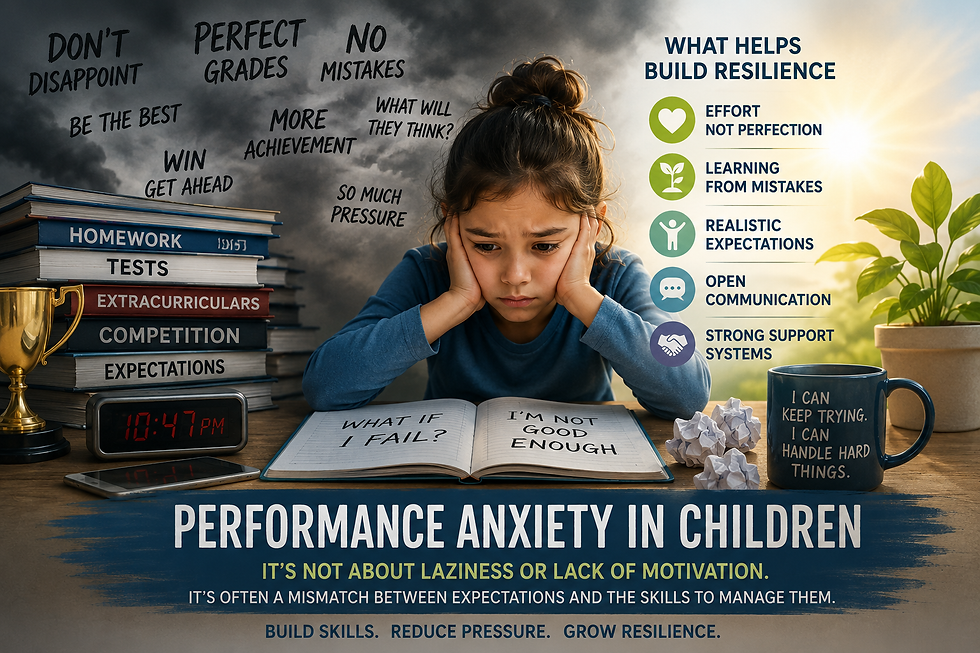
Over the past several years, many parents, educators, and mental health professionals have noticed a concerning shift in the emotional lives of children. Increasingly, children who appear bright, capable, and conscientious are presenting with significant levels of anxiety related to performance, achievement, and fear of failure. While anxiety surrounding grades, sports, auditions, and social acceptance has traditionally been associated with adolescence, clinicians are now observing similar concerns in children as young as seven and eight years of age.
A recent Reuters Health report highlighted what many child psychologists and psychiatrists have been observing in their practices: a dramatic increase in "performance anxiety" among children under the age of twelve. Parents describe children who become distressed when they make mistakes, avoid attempting unfamiliar tasks, seek constant reassurance, and experience emotional meltdowns when confronted with challenging schoolwork. These children are often highly motivated and eager to please. However, beneath their apparent diligence lies a persistent fear of not meeting expectations.
The phenomenon raises an important question. Why are so many children becoming anxious about performance at increasingly younger ages? The answer appears to lie at the intersection of several cultural and developmental trends. Modern childhood has become increasingly structured, achievement-oriented, and performance-driven. Children are exposed to academic expectations earlier than previous generations. Organized activities, competitive sports, enrichment programs, and social comparisons have become common features of childhood. At the same time, opportunities for unstructured play, experimentation, and learning through failure have declined. Children are frequently encouraged to excel but often receive less opportunity to develop the emotional skills required to tolerate mistakes, setbacks, and disappointment.
The research literature provides compelling evidence that perfectionism plays a significant role in this process. One of the largest studies examining perfectionism and school anxiety involved more than 2,100 children between the ages of eight and eleven years. Inglés and colleagues (2016) identified distinct profiles of perfectionism and found that children with elevated levels of perfectionistic concerns were significantly more likely to experience school-related anxiety. Their findings suggested that children who become preoccupied with mistakes, criticism, and meeting perceived expectations are particularly vulnerable to developing anxiety symptoms. Rather than serving as a motivator, perfectionism often becomes a source of emotional distress that interferes with learning and healthy development.
Subsequent research has reinforced these findings. Studies examining socially prescribed perfectionism—the belief that others expect perfection—have consistently linked this pattern to elevated anxiety, depression, and psychological distress. Researchers have increasingly concluded that it is not high standards themselves that create difficulties. Rather, problems emerge when children begin to view mistakes as evidence of personal inadequacy or fear that failure will result in disappointment, criticism, or loss of approval. Recent reviews published by the American Psychological Association have described socially prescribed perfectionism as one of the most significant psychological risks associated with contemporary achievement culture.
The relationship between anxiety and performance is further illustrated in studies examining specific forms of academic anxiety. Mammarella and colleagues investigated anxiety profiles among elementary school children and found that test anxiety, mathematics anxiety, and generalized anxiety frequently cluster together. Children who exhibited higher levels of anxiety also demonstrated lower self-concept and diminished confidence in their abilities. Importantly, resilience and positive self-perceptions appeared to buffer children from the harmful effects of performance-related stress. Their findings suggest that a child's emotional interpretation of challenges may be just as important as the challenge itself.
From a Positive Systems Approach perspective, however, performance anxiety cannot be fully understood through the lens of anxiety alone. It is equally important to examine the skills children possess for managing the demands being placed upon them. Two PSA Individual Factors are particularly relevant: coping skills and executive functioning.
Executive functioning refers to the cognitive processes that allow individuals to plan, organize, initiate tasks, regulate emotions, manage frustration, and persist in the face of difficulty. Contemporary research increasingly recognizes executive functioning as one of the most important developmental foundations for successful adaptation. Children who experience weaknesses in executive functioning often struggle to manage competing demands, organize complex assignments, recover from mistakes, and maintain emotional regulation when tasks become challenging. Recent reviews of executive functioning research emphasize that these abilities are central to children's capacity to navigate academic, social, and emotional demands successfully.
When viewed through this lens, many of the behaviours associated with performance anxiety begin to look very different. The child who refuses to begin a homework assignment may not be demonstrating oppositional behaviour. The child who repeatedly erases their work may not simply be striving for excellence. The child who becomes emotionally overwhelmed when faced with a difficult task may not be lacking motivation. In many cases, these behaviours reflect a mismatch between environmental demands and the child's current coping and self-management skills.
This distinction is critically important. When adults interpret anxiety-driven behaviour as laziness, defiance, or lack of effort, interventions often focus on increasing pressure and accountability. Unfortunately, this approach can intensify the very fears that are driving the behaviour. A child who already believes that mistakes are unacceptable may become even more anxious when confronted with criticism, punishment, or increased expectations.
The Positive Systems Approach encourages us to shift the question from "How do we get this child to perform?" to "What skills does this child need in order to manage the demands being placed upon them?" This subtle change in perspective often leads to very different interventions. Rather than focusing exclusively on outcomes, attention shifts toward developing emotional regulation, frustration tolerance, flexible thinking, problem-solving skills, self-advocacy, and resilience. The goal is not to eliminate expectations but to ensure that children possess the coping resources necessary to meet those expectations successfully.
Perhaps one of the greatest misconceptions surrounding performance anxiety is the assumption that children will simply outgrow it. The evidence suggests otherwise. Anxiety and perfectionism tend to reinforce one another over time, creating a cycle in which children become increasingly fearful of mistakes and increasingly dependent upon reassurance. Without intervention, this pattern can persist into adolescence and adulthood, contributing to chronic anxiety, burnout, and reduced psychological well-being.
The encouraging news is that resilience can be taught. Children develop confidence not by avoiding challenges but by learning that they can survive mistakes, setbacks, and disappointment. When parents and educators create environments that value effort, growth, and learning over perfection, children gradually develop a healthier relationship with achievement. Success becomes something to pursue rather than something to fear.
As the prevalence of performance anxiety continues to rise among younger children, it is increasingly important that we look beyond the behaviour itself and examine the developmental processes underlying it. From a Positive Systems Approach perspective, these children are not failing to cope because they lack motivation or character. More often, they are struggling because the expectations they face have outpaced the coping and executive functioning skills available to them. Understanding this distinction allows us to respond with empathy, support, and skill development rather than pressure and blame. In doing so, we help children develop something far more valuable than perfect performance: the confidence that they can handle whatever challenges life places before them.
For a deeper dive check out the studies and articles listed below:
Perfectionism and School Anxiety in Children
Inglés, C. J., García-Fernández, J. M., Vicent, M., Gonzálvez, C., Sanmartín, R., & Martínez-Monteagudo, M. C. (2016). Profiles of perfectionism and school anxiety: A review of the 2 × 2 model of dispositional perfectionism in child populations. Frontiers in Psychology, 7, 1403. https://doi.org/10.3389/fpsyg.2016.01403
This study examined over 2,000 children aged 8–11 years and found that children characterized by high levels of perfectionistic concerns experienced significantly greater school-related anxiety. The findings support the argument that perfectionism, particularly fear of mistakes and concern about evaluation, contributes to performance anxiety in childhood.
Child and Adolescent Perfectionism
Flett, G. L., Hewitt, P. L., Besser, A., Su, C., & Vaillancourt, T. (2016). The Child–Adolescent Perfectionism Scale: Development, psychometric properties, and associations with stress, distress, and psychiatric symptoms. Journal of Psychoeducational Assessment, 34(7), 634–652.
This important work by Gordon Flett and colleagues demonstrated that socially prescribed perfectionism—the belief that others expect perfection—is strongly associated with anxiety, stress, and emotional distress in children and adolescents. The study is particularly relevant to the increasing pressure many children experience from academic, athletic, and social expectations.
Anxiety Profiles in School-Aged Children
Mammarella, I. C., Donolato, E., Caviola, S., & Giofrè, D. (2018). Anxiety profiles and protective factors: A latent profile analysis in children. Personality and Individual Differences, 124, 201–208. https://doi.org/10.1016/j.paid.2017.12.017
This study examined 664 children in Grades 3–6 and identified distinct profiles of anxiety involving general anxiety, test anxiety, and mathematics anxiety. Children with higher anxiety profiles demonstrated lower self-concept and reduced resilience, highlighting the importance of protective factors in preventing performance-related anxiety.
Mathematics Anxiety and Performance Pressure
Mammarella, I. C., Caviola, S., Giofrè, D., & colleagues. (2023). Multidimensional components of (state) mathematics anxiety: Behavioral, emotional, cognitive, and psychophysiological responses to evaluative stress. Annals of the New York Academy of Sciences, 1524(1), 128–145.
This research demonstrated that even elementary-aged children experience measurable emotional and physiological stress responses when confronted with evaluative academic tasks. The study highlights how performance situations themselves can trigger anxiety responses that interfere with learning and problem solving.
Longitudinal Research on Perfectionism and Anxiety
Smith, M. M., Vidovic, V., Sherry, S. B., Stewart, S. H., & Saklofske, D. H. (2017). Are perfectionism dimensions risk factors for anxiety symptoms? A meta-analysis of 11 longitudinal studies. Anxiety, Stress, & Coping, 31(1), 4–20.
This meta-analysis found that perfectionistic concerns consistently predict increases in anxiety over time. The findings suggest that perfectionism is not simply associated with anxiety but may actively contribute to its development.
Achievement Culture and Child Mental Health
Curran, T., & Hill, A. P. (2019). Perfectionism is increasing over time: A meta-analysis of birth cohort differences from 1989 to 2016. Psychological Bulletin, 145(4), 410–429.
Although conducted primarily with adolescents and young adults, this landmark study demonstrated that socially prescribed perfectionism has increased substantially over recent decades. The authors argue that competitive educational environments and increasing societal expectations contribute to the rise in anxiety and emotional distress among young people.
Diamond, A. (2013). Executive functions. Annual Review of Psychology, 64, 135–168. https://doi.org/10.1146/annurev-psych-113011-143750
This is one of the most widely cited reviews of executive functioning. Diamond demonstrates that executive functions—including inhibitory control, working memory, cognitive flexibility, planning, and emotional self-regulation—are foundational for successful adaptation across academic, social, and emotional domains. Deficits in these areas can leave children vulnerable to becoming overwhelmed when faced with performance demands.
Executive Functioning and Academic Success
Best, J. R., Miller, P. H., & Naglieri, J. A. (2011). Relations between executive function and academic achievement from ages 5 to 17 in a large, representative national sample. Learning and Individual Differences, 21(4), 327–336.
This study demonstrated strong relationships between executive functioning abilities and academic achievement throughout childhood and adolescence. Children with stronger executive functioning skills were better able to manage academic demands and cope with challenging tasks.
Relevance to PSA Framework
Masten, A. S. (2014). Ordinary Magic: Resilience in Development. New York: Guilford Press.
Masten's work demonstrates that resilience emerges from ordinary developmental systems, including self-regulation, supportive relationships, problem-solving abilities, and adaptive coping skills. This aligns remarkably well with the Positive Systems Approach emphasis on building competencies and strengthening individual and environmental supports rather than focusing solely on symptom reduction.


Comments