
Positive Re-Direction Through a Regulation-Informed Lens: When Behaviour Is a Stress Response
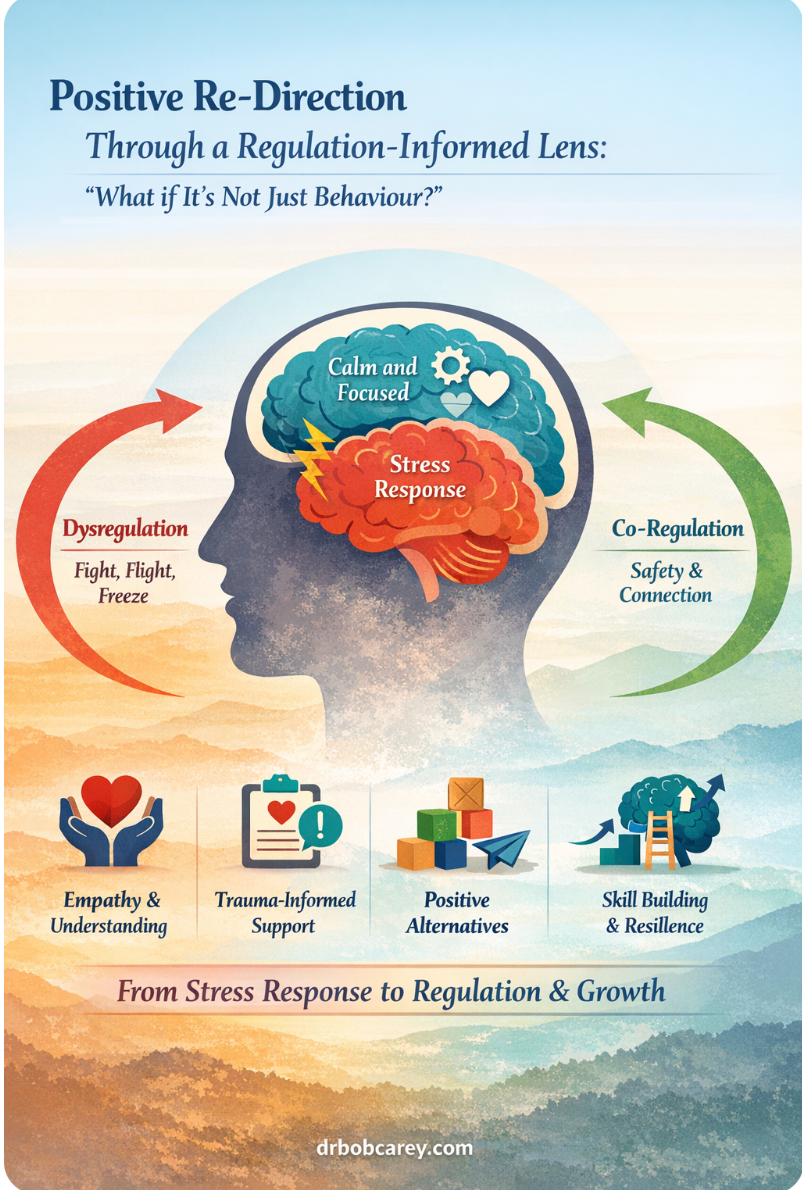
Positive re-direction becomes significantly more effective when viewed through the lens presented in my book: What If It’s Not Just the Behaviour?, where behaviour is understood not as a simple matter of choice, but as an expression of nervous system state. From this perspective, challenging behavior is frequently a manifestation of stress activation rather than intentional noncompliance. When the brain is operating outside the window of tolerance, access to executive functioning, emotional regulation, and cognitive flexibility is compromised. In these moments, traditional discipline strategies that rely on verbal reasoning or consequences often fail to produce meaningful change.
A regulation-informed approach reframes positive re-direction as a bottom-up intervention rather than a top-down behavioural correction. Instead of focusing solely on stopping unwanted behaviour, the emphasis shifts toward stabilizing physiological and emotional state so learning and adaptive functioning can resume. This aligns with the core framework outlined in What If It’s Not Just the Behaviour?, which highlights that sustainable behaviour change occurs only when the nervous system is sufficiently regulated to support engagement, problem-solving, and impulse control.
When individuals experience stress activation, their brain prioritizes survival over cooperation. Attempts to reason, lecture, or correct during these states may inadvertently increase threat perception and escalate dysregulation. Positive re-direction, when grounded in nervous system awareness, interrupts this cycle by providing relational safety and regulatory support first. This often involves reducing environmental demands, introducing movement or sensory input, offering structured alternatives, or guiding attention toward activities that promote stabilization.
Central to this process is co-regulation. Before self-regulation can develop, individuals—particularly children—require repeated experiences of being regulated with. Calm vocal tone, predictable responses, slowed pacing, and emotional attunement provide external regulation that gradually strengthens internal capacity. In clinical practice, this is understood as building neural pathways associated with emotional regulation and stress recovery. Positive re-direction becomes most effective when delivered from this co-regulated state rather than during heightened emotional reactivity.
Language also plays a critical role. Regulation-informed communication avoids shame-based framing and instead emphasizes validation combined with guidance. Acknowledging emotional experience before offering redirection supports relational trust and reduces defensive responses. Over time, this approach strengthens emotional literacy and supports the development of adaptive coping strategies.
Another foundational concept emphasized throughout What If It’s Not Just the Behaviour? is predictability. The nervous system responds positively to consistent routines, clear expectations, and stable relational responses. When individuals know what to expect, their baseline stress load decreases, allowing greater access to higher-level cognitive functioning. Positive re-direction works most effectively when embedded within environments that prioritize structure, routine, and emotional safety.
Importantly, these principles extend beyond childhood behavior support. Adults experience the same neurobiological constraints under stress. When overwhelmed, fatigued, or emotionally activated, executive functioning becomes less accessible. Applying positive re-direction inwardly—by shifting from self-critical thought patterns to compassionate self-talk, by breaking tasks into smaller steps, or by intentionally engaging in regulating activities—reflects the same bottom-up framework used in child development. This reinforces the universality of nervous system-based behavior support.
From a clinical standpoint, the long-term value of positive re-direction lies not in immediate compliance, but in skill acquisition. When individuals repeatedly experience supportive guidance rather than punitive correction, they develop stronger self-regulation capacity, improved emotional awareness, and increased relational security. These outcomes align directly with the developmental goals outlined throughout What If It’s Not Just Behaviour?, where emphasis is placed on building resilience, flexibility, and nervous system stability rather than enforcing surface-level behavior control.
Positive re-direction ultimately represents a paradigm shift in how behaviour is understood and addressed. It moves practice away from symptom management and toward systems-based intervention that considers neurological state, relational context, and environmental demand. When caregivers, educators, and clinicians adopt this framework, moments of dysregulation become opportunities for teaching regulation, strengthening connection, and promoting long-term adaptive functioning.
By integrating nervous system science with intentional redirection strategies, we create conditions that support emotional safety, developmental growth, and sustainable behavior change. This approach does not eliminate challenges, but it fundamentally transforms how those challenges are addressed.


Comments