
Advocacy Without Confrontation: Using PSA in School Meetings
- drbobcarey
- Feb 9
- 6 min read

For many parents, school meetings feel less like collaboration and more like combat. Whether it’s an IEP meeting, a behaviour review, or a “we need to talk about your child” phone call, the emotional stakes are high. Parents often arrive prepared to defend their child, while schools arrive prepared to manage behaviour. That mismatch can quickly turn conversations adversarial.
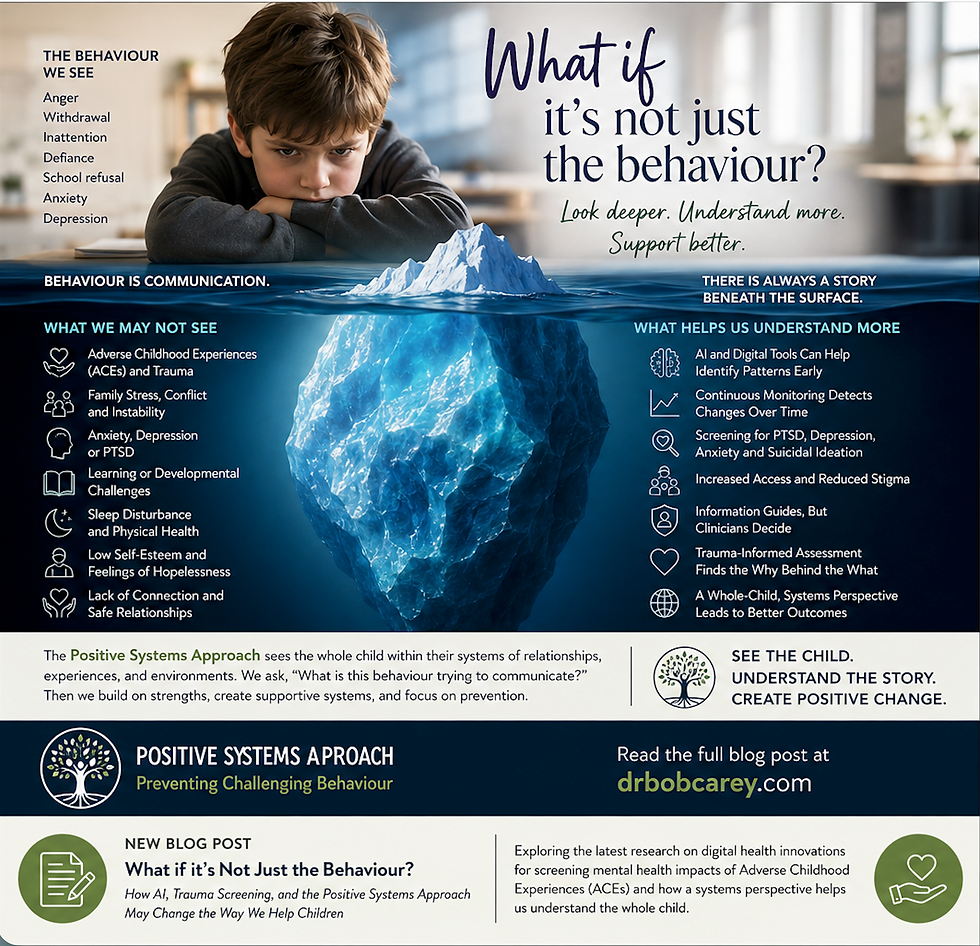
In What if It’s Not Just the Behaviour?, I introduce the Positive Systems Approach (PSA) as a way to fundamentally change that dynamic. PSA helps parents move from being reactive advocates to becoming system analysts—calm, strategic partners who understand how behaviour emerges within systems and how systems can be adjusted to support success. When parents adopt this mindset, school meetings stop being about blame, discipline, or control—and start becoming about understanding, design, and collaboration.
From Emotional Advocacy to Strategic Advocacy
Traditional advocacy often sounds like this:
“They’re punishing my child unfairly.”
“You don’t understand my child.”
“This plan isn’t working.”
While these statements may be valid, they can unintentionally escalate defensiveness. PSA offers a different route—one that is non-confrontational but highly effective. The core shift is this:Instead of arguing about behaviour, we analyze the system producing it.
When parents speak the language of systems, schools tend to listen differently. You’re no longer asking for exceptions—you’re asking for better data, better understanding, and better design.
Novel Angle: Using “We” Language to Create Partnership
One of the most powerful (and underused) advocacy tools is “we” language. “We” language subtly but effectively reframes the meeting from us versus them to a shared problem-solving task. It signals collaboration, not compliance—and not conflict.
Instead of saying:
“You’re not meeting my child’s needs”
Try:
“How can we adjust the environment so this behaviour is less likely to occur?”
Instead of:
“This plan is punishing my child”
Try:
“How do we make sure the plan is teaching skills, not just stopping behaviour?”
In PSA terms, this matters because behaviour is not viewed as a personal flaw—it’s viewed as communication within a system. When parents use “we” language, they are implicitly saying: I understand this is a system issue, not a people issue. That alone lowers resistance and opens the door to more meaningful problem-solving.
Key Insight: Asking for an FBA That Looks for the “Why”
Many parents are told their child “needs consequences,” “needs structure,” or “needs firmer limits.” What often gets missed is the most important question of all: Why is the behaviour happening? This is where a Functional Behaviour Assessment (FBA) becomes critical—but only if it’s done properly.
A PSA-aligned FBA does not focus on:
Suppressing behaviour
Escalating consequences
Removing the child from environments
Instead, it asks:
What triggers the behaviour?
What need is being communicated?
What does the child gain or avoid through the behaviour?
What skills are missing?
In What if It’s Not Just the Behaviour?, I emphasize that behaviour is functional—it serves a purpose for the child. If we don’t understand that purpose, we risk designing interventions that manage adults’ discomfort rather than supporting children’s growth.
Language parents can use in meetings:
“Can we ensure the FBA is focused on understanding the function of the behaviour, not just stopping it?”
“What hypotheses are we exploring about why this behaviour occurs in this setting?”
“How will the assessment guide skill-building rather than response suppression?”
These questions position parents as informed collaborators—not adversaries.
Practical Tip: Document Diligently (and Objectively)
One of the most practical PSA strategies I teach parents is documenting behaviour like a system analyst, not like a frustrated witness.
This means keeping objective, neutral records that track:
Triggers (what happened before)
Behaviour (what was observable)
Outcomes (what happened after)
Successes (when things went well and why)
This kind of documentation does two powerful things:
It reduces emotional escalation in meetings.
It provides concrete data that professionals can actually use.
PSA-style documentation focuses on patterns, not blame.
Instead of:
“The teacher always escalates things”
Try recording:
“Transitions after recess appear to increase dysregulation.”
“Positive behaviour improved when expectations were previewed.”
When parents bring clear, pattern-based information into meetings, they change the tone instantly. The conversation shifts from opinion to analysis—and systems respond to data.
Becoming a System Analyst, Not a Combatant
PSA does not ask parents to be passive. It asks them to be strategic.
When you:
Use “we” language
Request function-based assessments
Share objective documentation
…you are no longer fighting the school. You are helping the school see the system more clearly.
That’s the heart of advocacy without confrontation. And that’s the role parents are invited into in What if It’s Not Just the Behaviour?: not just advocates for their child—but architects of better systems.
If school meetings have felt overwhelming, discouraging, or adversarial, PSA offers a different path—one grounded in understanding, collaboration, and long-term change.
Below is a case study showing how PSA works to turn conflict into collaboration:
Case Study: Turning a Contentious School Meeting into a Collaborative Problem-Solving Session
Background
Ethan is a 9-year-old student in Grade 4 who had begun receiving frequent calls home for “disruptive behaviour.” The school documented refusal to work, leaving his seat, and verbal outbursts during class. Meetings with the school had become tense, with a strong emphasis on consequences, loss of privileges, and increasing time out of the classroom.
Ethan’s mother arrived at the next school meeting prepared—but not to argue. She had read What if It’s Not Just the Behaviour? and approached the meeting as a system analyst, not a defensive parent.
Step 1: Shifting the Tone with “We” Language
Instead of opening with frustration, Ethan’s mother began with this:
“I think we all want the same thing here—Ethan being successful and feeling safe at school. I’m hoping we can look at this together and figure out what the system might be asking of him that’s hard right now.”
That single shift changed the emotional temperature in the room. Teachers relaxed. The conversation moved from who’s responsible to what’s happening.
Rather than challenging staff decisions, she consistently used language like:
“What are we noticing about when these behaviours happen?”
“How can we adjust the environment to reduce these situations?”
“What supports can we put in place before things escalate?”
This aligned perfectly with the Positive Systems Approach—viewing behaviour as a response to conditions, not a character flaw.
Step 2: Advocating for a Function-Based FBA
Previously, the school’s approach had focused on stopping Ethan’s behaviour through removal from class. Ethan’s mother gently redirected the conversation:
“I’m wondering if we could request a Functional Behaviour Assessment that really looks at why this behaviour is happening—not just what to do when it occurs.”
She clarified that she wasn’t opposed to structure or expectations, but wanted to ensure the assessment:
Examined triggers, not just incidents
Looked at skill gaps and stressors
Focused on teaching replacement skills, not suppressing behaviour
This reframing helped the team recognize that Ethan’s behaviour might be functional, not defiant. The school agreed to proceed with an FBA focused on understanding function rather than increasing consequences.
Step 3: Documenting Diligently to Support Collaboration
Rather than bringing emotional anecdotes, Ethan’s mother shared simple, objective documentation she had been keeping at home:
Ethan’s outbursts increased after long writing tasks
Behaviour improved significantly when instructions were broken into smaller steps
Transitions and unstructured time were consistent triggers
Positive days correlated with predictable routines and previewed expectations
She presented this not as evidence against the school, but as data to support shared problem-solving.
“I thought this might help us see some patterns we can all work with.”
The team immediately began making connections between her notes and classroom observations.
The Outcome: A System Adjustment, Not a Power Struggle
With the FBA completed, the team identified that Ethan’s behaviour primarily served an escape function during tasks that overwhelmed his executive functioning skills.
Instead of escalating consequences, the school implemented:
Reduced task length with built-in breaks
Visual schedules and transition warnings
Pre-teaching expectations before difficult activities
A safe check-in system with a trusted staff member
Within weeks:
Classroom removals dropped significantly
Ethan’s engagement improved
School communication shifted from crisis-driven to collaborative
Most importantly, Ethan no longer felt like “the problem.” The system had changed to support him.
Why This Case Study Matters
This is what advocacy without confrontation looks like in real life.
Not louder voices. Not harder consequences. Not more meetings filled with tension.
Instead:
Strategic language
Function-focused assessment
Objective documentation
A systems mindset
When parents step into the role of system analysts, schools stop feeling challenged—and start feeling supported.
And that’s when real change happens.


Comments