
The Myth of the "Broken" Child: A Psychologist’s Take on Ontario’s Mental Health Crisis
- drbobcarey
- Feb 15
- 5 min read

As a psychologist, I often find that the most profound insights come not from looking deeper into a child’s mind, but by stepping back to view the entire world they inhabit. A recent report from the Centre for Addiction and Mental Health (CAMH) (see source link below) provides a sobering example of why this systemic perspective is more critical now than ever.
The Findings: A System Under Strain
The CAMH article highlights a distressing trend: emergency department visits for mental health concerns among Ontario’s youth—particularly those aged 10 to 17—have surged dramatically over the last decade. While the data shows a 22% increase in youth emergency visits for mental health between 2010 and 2020, the more alarming figure is the nearly 80% rise in visits specifically related to self-harm and suicidality.
Perhaps most telling is the context of these visits. The report suggests that many of these families are turning to the emergency room not as a first choice, but as a last resort because the community-based support systems—the "middle" tier of care—are either non-existent or carry waiting lists that span months or even years. It is a picture of a safety net that has become too frayed to catch our children before they hit the ground.
In addition, a recent poll conducted in the U.S. by the Children’s Health Council (CHC) (see source link below) reveals a staggering mental health crisis among Gen Z, with 94% of youth reporting regular mental health challenges and nearly half experiencing these struggles daily. The survey highlights a significant "understanding gap," as 60% of youth feel their parents do not fully grasp the severity of their mental health issues, despite 80% of parents believing they have a strong understanding of their child's well-being. This disconnect is further complicated by systemic barriers, including a lack of affordable care and a shortage of diverse providers, leading many young people to turn to social media for support. While the findings underscore a generation that is increasingly open about their struggles, they also call for urgent improvements in clinical resources and more authentic, supportive communication between generations.
More evidence of the crisis in youth mental health comes from a recent UNICEF report (see source link below) which reveals that Canadian youth are significantly struggling with social connection, with one in three reporting difficulty making friends and many experiencing regular bullying. These social challenges are compounded by a lack of "middle-tier" community support, leaving families to navigate complex emotional and relational issues without adequate guidance. The report emphasizes that these struggles are not just individual hurdles but are deeply tied to the environments—schools, neighborhoods, and digital spaces—where children spend their time.
Moving Beyond "Just Behaviour"
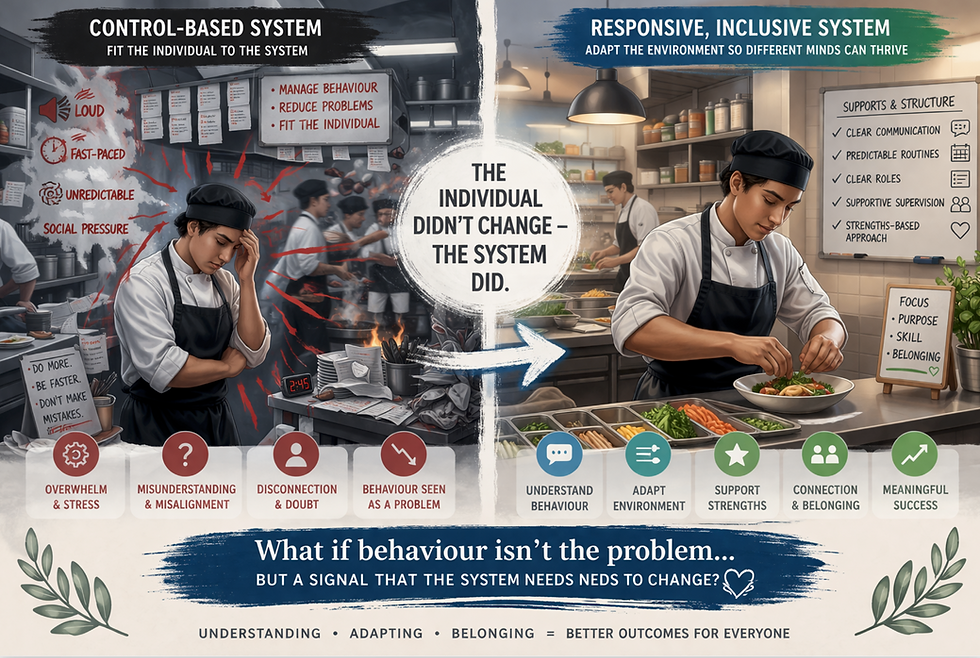
In my work, I often reference the Positive Systems Approach (PSA), a framework that challenges the traditional medical model of "fixing" an individual’s pathology. When we see the statistics such as those provided from CAMH, the instinct of our current medical system is to ask: “What is wrong with these children? What disorder do they have?”
But the Positive Systems Approach asks a different, more compassionate question: “What is happening in the system around these children that makes this level of distress a logical outcome?”.
As I explore in What if it's Not Just the Behaviour? (see source link below), we must view a child’s actions—even the most disruptive or self-destructive ones—as a form of communication. These emergency room visits are a collective cry from a generation of youth who are navigating a system that lacks the "Individual Factors" of adequate coping skills training and the "System Factors" of consistency, flexibility, and intensity of support.
The Myth of Individual Pathology
When we label a child’s struggle as purely "internal" or "pathological," we inadvertently place the entire burden of recovery on their small shoulders. The PSA framework reminds us that behaviour does not exist in a vacuum; it is shaped by a "complex web of interactions and influences," including the family, the school, and the wider community.
The Positive Systems Approach (PSA) conceptualizes these findings not as a reflection of "broken" children, but as a clear sign of systemic failure. Here is how PSA would frame the issue:
Behaviour as Communication: From a PSA lens, difficulty making friends or withdrawing due to bullying is a form of communication. It signals that the child’s environment may lack the necessary "System Factors"—like safety, predictability, and social-emotional coaching—required for them to thrive.
The "Skill vs. Will" Gap: PSA asks whether these social struggles are a "skill problem". Many youth lack the specific coping and social skills needed to navigate modern peer dynamics. Instead of punishing a child for being "antisocial," PSA advocates for directly teaching skills like conflict resolution and emotional regulation.
Systemic Interconnectedness: The approach views a child as a "planet" orbited by "moons" like school, family, and friendships. If a child is bullied at school, the "ripple effect" creates stress that impacts their behaviour at home. PSA would focus on changing the system factors—such as increasing "System Flexibility" in schools and improving "Team Health" between parents and educators—to create a more supportive "eco-system" around the child.
Moving Beyond Individual Pathology: Rather than labeling a lonely child as "socially anxious" (individual pathology), PSA shifts the focus to Environmental Modifications. It asks: Does the current school or community system provide enough "Intensity" of positive reinforcement and connection to outweigh the negative impacts of bullying?
If we look at the CAMH data through the lens of Systems Thinking, we see a failure of the "System Factors". Specifically:
Lack of System Flexibility: Our schools and community services are often too rigid to adapt to the unique neurobiological and emotional needs of children, forcing them into "one-size-fits-all" environments that trigger outbursts or withdrawal.
Insufficient Intensity: The PSA model notes that for lasting change, we often need 10x the positive reinforcement and support we expect. Instead, our current societal system offers "low-intensity" support (long waitlists, brief check-ins) until a crisis hits, at which point the intensity becomes "reactive" rather than "proactive".
A Breakdown in Team/Family Health: When caregivers are stressed by economic instability, lack of resources, and a lack of societal "portability" in care, the entire family system suffers.
A Call for Systemic Change
The rise in emergency visits is not a sign of a "broken generation"; it is a sign of a broken system. We cannot continue to treat youth mental health as a series of isolated "fires" to be extinguished in the ER.
The Positive Systems Approach advocates for Early Identification and Collaborative Problem-Solving—not just within the family, but across the entire social system. We must move the focus from "punishing" and/or suppressing symptoms to "teaching" skills and "adjusting" the environment.
As a psychologist, my message to parents and policymakers alike is this: Your child’s distress is likely not "just the behaviour" or a permanent flaw in their character. It is a signal that the system around them—our society—is failing to provide the safety, predictability, and support they need to thrive.If we want to see those CAMH numbers go down, we must stop trying to "fix" the children and start repairing the systems that are meant to hold them. True healing begins when we build a world where a child doesn't have to reach a point of crisis just to be heard.
Articles Referenced:
Emergency visits by Ontario youth for mental health, addiction increase by 32 per cent over six years, CAMH, https://www.camh.ca/en/camh-news-and-stories/emergency-visits-by-ontario-youth-form-mental-health?utm_source=chatgpt.com
NEW POLL: 94% OF GEN Z YOUTH REPORT EXPERIENCING REGULAR MENTAL HEALTH CHALLENGES, Sept 30, 2025. https://www.prnewswire.com/news-releases/new-poll-94-of-gen-z-youth-report-experiencing-regular-mental-health-challenges-302570254.html?utm_source=chatgpt.com
Canadian youth struggle with making friends and bullying: UNICEF report, May, 2025 https://toronto.citynews.ca/2025/05/13/canadian-youth-struggle-with-making-friends-and-bullying-unicef-report/?utm_source=chatgpt.com
What if it’s Not Just the Behaviour? A New Way of Parenting with a Positive Systems Approach.



Comments