
The Relationships Around Children Matter More Than We Sometimes Realize
When parents seek support for concerns about their child's emotional wellbeing, the conversation often begins with the issue that feels most immediate. Perhaps a child is struggling with anxiety, having difficulty regulating emotions, withdrawing socially, or experiencing challenges at school. Understandably, attention is often directed toward the child and the symptoms that have become most visible.
Yet one of the most consistent findings in developmental psychology suggests that understanding children's wellbeing requires us to look beyond the child alone. Children's development unfolds within a network of interconnected relationships and environments, and among these influences, the quality of family relationships appears to play a particularly important role. This is not a new idea. In fact, some of the most influential studies in child development have been pointing us in this direction for decades.
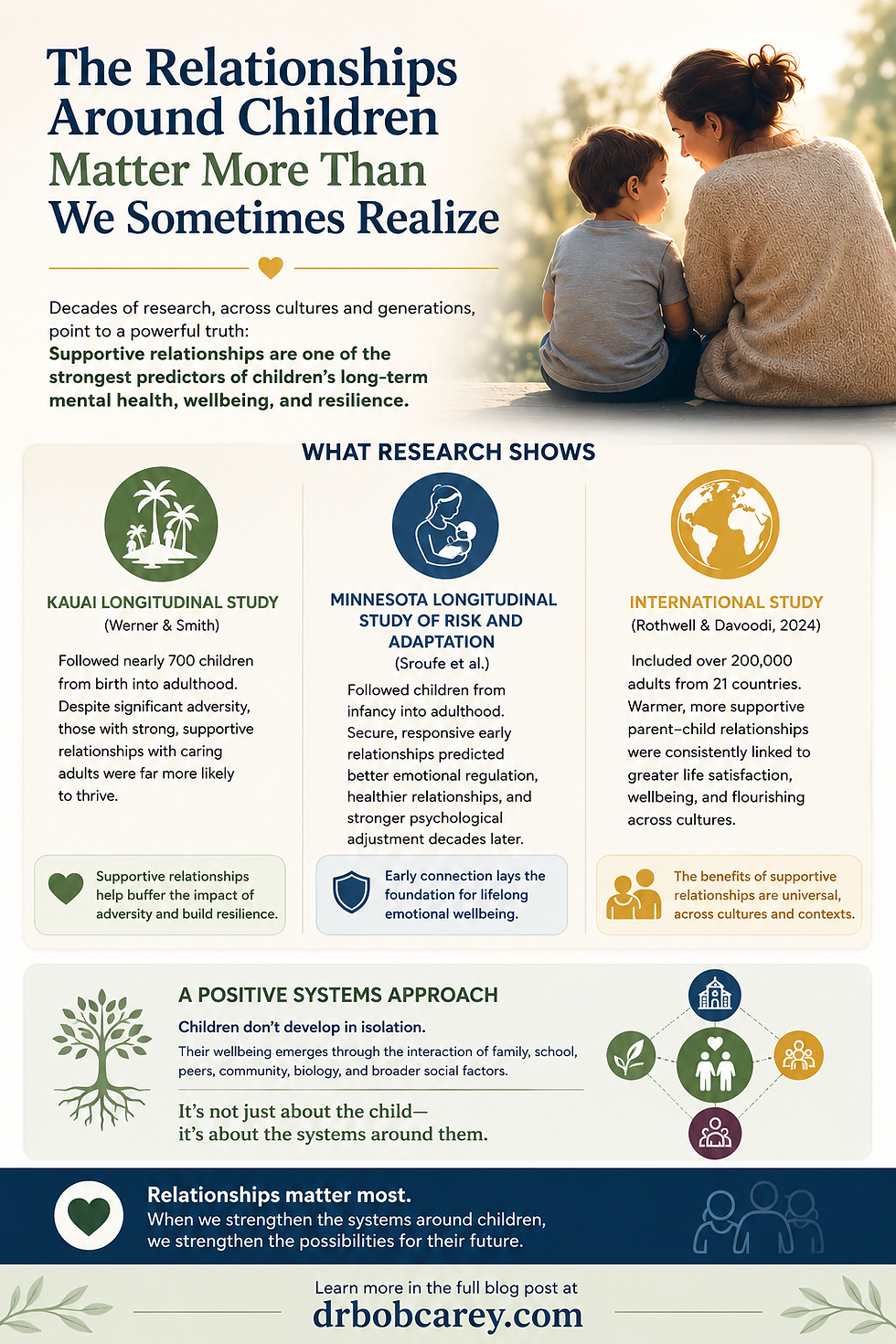
One of the best-known examples is the Kauai Longitudinal Study, conducted by researchers Emmy Werner and Ruth Smith. This study followed nearly 700 children born on the Hawaiian island of Kauai and tracked their development into adulthood. Many of these children grew up facing significant adversity, including poverty, family instability, parental mental illness, and other life stressors. Despite these challenges, a substantial number developed into competent, emotionally healthy adults. What distinguished these resilient individuals was not the absence of hardship, but the presence of supportive relationships. Children who had strong emotional connections with caring adults—often parents or other close family members—were far more likely to achieve positive outcomes later in life. The study became one of the foundational pieces of evidence demonstrating that supportive family relationships can act as powerful protective factors against the negative effects of adversity. What researchers found was both interesting and hopeful. While some children struggled, many grew into healthy, competent, and emotionally well-adjusted adults despite the challenges they had faced. As researchers examined what distinguished these individuals, one factor appeared repeatedly: supportive relationships. Children who had strong emotional connections with caring adults, often within their families, were more likely to demonstrate resilience and positive adaptation over time. Importantly, this finding did not suggest that relationships eliminate adversity or guarantee positive outcomes. Human development is rarely that simple. Rather, the presence of supportive relationships appeared to help buffer some of the effects of difficult circumstances and provide children with resources that supported their long-term wellbeing.
Several decades later, the Minnesota Longitudinal Study of Risk and Adaptation provided additional insight into the importance of early relationships. Researchers followed children from infancy into adulthood, examining how early experiences with caregivers influenced later development. The findings suggested that children who experienced secure and responsive relationships with caregivers during their earliest years tended to demonstrate stronger emotional regulation, healthier interpersonal relationships, and better psychological adjustment later in life. These early relationships appeared to provide a foundation from which children learned important lessons about trust, safety, emotional expression, and connection. Again, caution is important when interpreting these findings. Secure attachment in infancy does not determine a child's future, nor does it guarantee emotional wellbeing. Children's lives are shaped by many experiences across development. Nevertheless, the study suggests that early relationships may create developmental pathways that continue to influence wellbeing for years to come.
More recently, a large international study by researchers Jonathan Rothwell and Sina Davoodi extended these findings into a contemporary and global context. The study included more than 200,000 adults from 21 countries and examined the relationship between childhood experiences and adult wellbeing. Participants who reported warmer and more supportive relationships with their parents during childhood were more likely to report greater life satisfaction, psychological wellbeing, and overall flourishing as adults. What many researchers found particularly noteworthy was the consistency of these findings across cultures. Although families differ enormously in structure, values, traditions, and circumstances, the experience of feeling supported and connected within important relationships appeared to be associated with positive outcomes across a wide range of contexts.
Together, these studies span more than four decades of research and include participants from childhood through adulthood, as well as populations from around the world. Despite differences in methodology, geography, and historical context, they converge on the same conclusion: children are more likely to thrive when they experience strong, supportive, and secure relationships within their families. Family resilience and parent-child connection do not simply help children feel better in the moment—they are among the strongest predictors of long-term mental health, well-being, and resilience throughout life.
From a Positive Systems Approach perspective, these findings are especially meaningful. One of the core ideas of systems thinking is that children's challenges and successes rarely reside solely within the child. Rather, development emerges through the ongoing interaction of multiple influences, including family relationships, school environments, peer experiences, community supports, biological factors, and broader social contexts. When viewed through this lens, parent-child connection is not simply another variable to consider. It is part of a larger system that interacts with many other influences in a child's life.
For example, a child who struggles with anxiety may still thrive when surrounded by supportive relationships, effective school supports, positive peer connections, and opportunities for meaningful success. Similarly, a child who experiences learning difficulties may demonstrate remarkable resilience when caregivers, educators, and other important adults work together to create an environment that promotes understanding, encouragement, and growth.
This broader perspective helps move us away from asking, "What is wrong with this child?" and toward asking, "What systems are surrounding this child, and how are those systems supporting development?" In practice, I find this to be one of the most hopeful aspects of systems thinking. It reminds us that supporting children's wellbeing does not always require changing the child. Sometimes meaningful change occurs when we strengthen the relationships, environments, and supports that surround them.
For parents, this perspective may also offer some reassurance. Research on parent-child relationships is not suggesting that parents must be perfect, nor does it imply that every future outcome rests on their shoulders. Families are often making the best decisions they can within the circumstances they face. Children are remarkably complex, and development is influenced by countless factors, many of which are beyond any individual's control.
What the research appears to suggest is something both simpler and more profound. Across many different studies, cultures, and generations, children seem to benefit when they experience consistent connection, support, and care from the important people in their lives.
While there is no single ingredient that guarantees positive mental health outcomes, supportive relationships appear to be one factor that consistently matters.
Perhaps that is one of the most enduring lessons from developmental science. Children do not develop in isolation. They develop within families, schools, friendships, communities, and other interconnected systems. Understanding those systems may ultimately help us better understand not only children's difficulties, but also their remarkable capacity for resilience, growth, and wellbeing.
Want to dive deeper? References:
Werner, E. E. (1993). Risk, resilience, and recovery: Perspectives from the Kauai Longitudinal Study. Development and Psychopathology, 5(4), 503–515.
Werner, E. E., & Smith, R. S. (2001). Journeys from childhood to midlife: Risk, resilience, and recovery. Cornell University Press.
Rothwell, J. T., & Davoodi, T. (2024). Parent-child relationship quality predicts higher subjective well-being in adulthood across a diverse group of countries. Communications Psychology, 2, Article 110. https://doi.org/10.1038/s44271-024-00161-x
Sroufe, L. A., Egeland, B., Carlson, E. A., & Collins, W. A. (2005). The development of the person: The Minnesota study of risk and adaptation from birth to adulthood. Guilford Press.


Comments