
What If It's Not Just the Behaviour? Understanding Children Through a Positive Systems Lens"
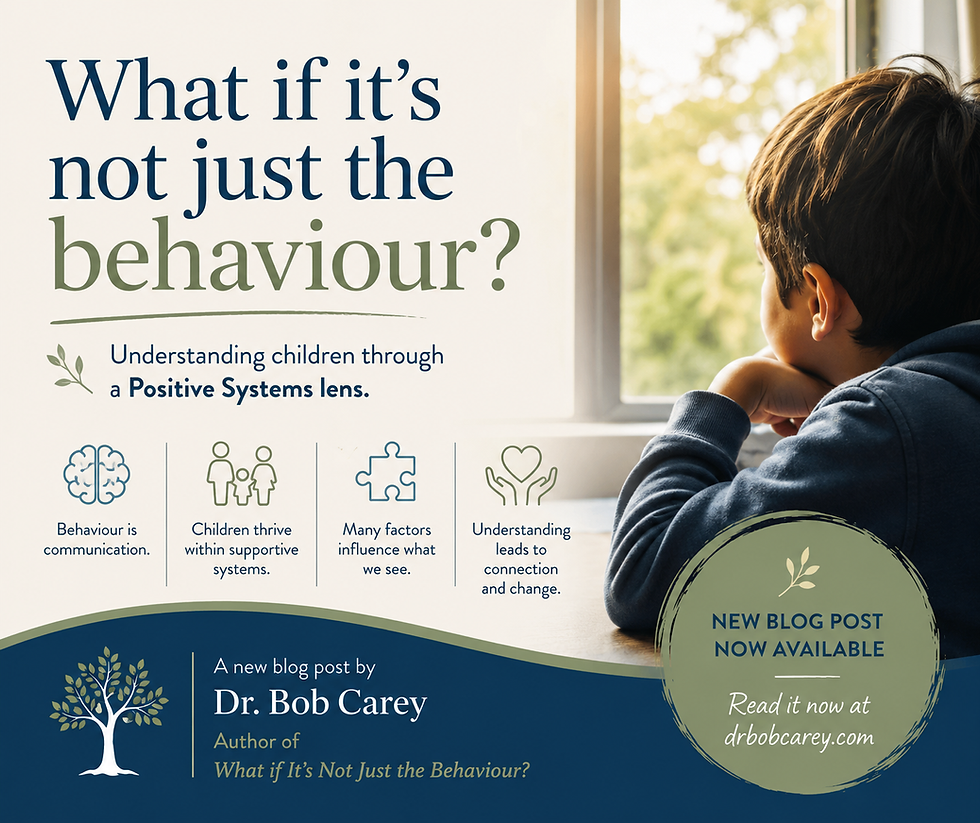
Over the years, I have noticed a common pattern in the conversations with parents. They rarely begin by talking about relationships, emotional regulation, executive functioning, family stress, developmental differences, or environmental factors. Those things usually emerge later. The conversation almost always begins with behaviour.
A parent describes the explosive tantrums that seem to appear out of nowhere. Another talks about a child who argues endlessly over even the smallest requests. Some describe school refusal, aggression toward siblings, emotional outbursts, anxiety that has gradually taken over family life, or a child who seems constantly angry and oppositional. By the time many families seek support, they are exhausted. They have tried consequences, rewards, stern conversations, removing privileges, sticker charts, and advice from well-meaning friends and family members. Yet despite everyone's efforts, the same struggles continue to surface. Understandably, the behaviour becomes the focus. After all, behaviour is what disrupts dinner, creates tension at school, strains family relationships, and leaves parents lying awake at night wondering what they are doing wrong. Yet one of the most important lessons I have learned throughout my career is that behaviour often tells us far less than we think it does. Behaviour is visible. The factors that contribute to behaviour often are not.
When parents first hear the phrase What if it's not just the behaviour? they sometimes assume I am suggesting that behaviour doesn't matter. In reality, the opposite is true. Behaviour matters enormously. It can affect learning, relationships, emotional wellbeing, family functioning, and future opportunities. The challenge is that behaviour is often the final chapter in a story that began much earlier. However, when we focus exclusively on the behaviour itself, we can find ourselves trying to solve the wrong problem.
I often think about a family I worked with several years ago. I'll call the child Ethan. Ethan was nine years old and had developed a reputation at school for being defiant and disruptive. His teachers described him as argumentative, easily frustrated, and unwilling to follow instructions. At home, his parents reported frequent emotional explosions that seemed wildly disproportionate to the situations that triggered them. If a sibling touched one of his belongings, he erupted. If plans changed unexpectedly, he became inconsolable. Homework often ended in tears, yelling, and slammed doors. By the time I met the family, everyone was focused on stopping the behaviour. The school wanted strategies to reduce the outbursts. His parents wanted to know which consequences would be most effective. Ethan's younger sister had begun avoiding him because she never knew when he might explode. At first glance, it looked like a behaviour problem. But as we explored the situation more deeply, a different picture emerged. Ethan was struggling with anxiety that nobody had fully recognized. He was expending enormous energy each day trying to hold himself together socially and academically. He worried constantly about making mistakes. He interpreted minor corrections as criticism. His executive functioning skills lagged behind those of many of his peers, making organization and task completion genuinely difficult. By the time he arrived home from school, his emotional reserves were depleted. The outbursts that everyone wanted to eliminate were not the primary problem. They were the visible result of a much larger collection of challenges that had been quietly building beneath the surface. Once his parents and teachers began to understand what was driving the behaviour, their responses changed. They became less focused on control and more focused on support. Expectations remained, but the approach shifted. More structure was introduced. Anxiety was addressed directly. Emotional regulation skills were taught explicitly. Adults became more attentive to the signs that Ethan was becoming overwhelmed long before an explosion occurred.
Interestingly, as those underlying issues were addressed, the behaviour that had originally brought everyone together began to improve. Not because anyone had found a better punishment. Not because Ethan suddenly decided to behave. But because the system surrounding him had become more responsive to what he actually needed. Experiences like this have shaped the development of what I call the Positive Systems Approach. At its core, the approach is based on a simple but often overlooked idea: children do not exist in isolation. Their behaviour is influenced by a constantly interacting network of developmental, emotional, relational, environmental, and social factors. This may seem obvious when stated aloud, yet our responses to behaviour often suggest otherwise.
When a child struggles, our attention tends to narrow. We search for the problematic behaviour, identify ways to reduce it, and look for strategies to increase compliance. In some situations, these approaches may provide short-term improvements. However, when they become our primary focus, we risk overlooking the very factors that are maintaining the difficulties in the first place. One of the most powerful shifts that occurs when parents begin thinking systemically is that they become more curious. Instead of asking, "How do I stop this behaviour?" they begin asking questions such as, "What might be contributing to this?" or "What is my child experiencing that I may not fully understand?" These questions rarely produce simple answers.
Sometimes behaviour reflects developmental challenges. Children are frequently expected to demonstrate skills that are still under construction. Emotional regulation, impulse control, planning, organization, frustration tolerance, perspective-taking, and problem-solving all develop gradually over time. When adults misinterpret skill deficits as behavioural choices, both frustration and conflict tend to increase. I often explain this to parents by asking them to imagine a child learning to ride a bicycle. If the child repeatedly falls, we would not assume they are choosing to fail. We recognize that the necessary skills have not yet fully developed. We provide support, coaching, practice, and patience. Yet when emotional or behavioural skills are underdeveloped, we sometimes assume the child simply isn't trying hard enough. The reality is often far more complicated.
Another family comes to mind as I write this. Twelve-year-old Maya had become increasingly oppositional at home. Every request seemed to spark an argument. Her parents felt as though they were constantly walking into battles they never intended to have. Mornings were difficult. Homework was difficult. Bedtime was difficult. Family outings frequently ended in conflict. The more frustrated her parents became, the stricter they grew. The stricter they became, the more resistant Maya appeared. Everyone was trapped in a cycle that left them feeling disconnected and defeated. As we explored the situation together, it became apparent that much of Maya's behaviour was rooted in a growing need for autonomy. She was entering adolescence and desperately wanted a greater sense of control over her own life. At the same time, she struggled with anxiety and perfectionism, which made everyday demands feel far more overwhelming than adults realized. What appeared to be defiance was often a mixture of fear, frustration, and an age-appropriate desire for independence. The solution was not to remove expectations. Nor was it to allow Maya to make all of the decisions. Instead, the family began looking for opportunities to increase collaboration. They involved her more actively in problem-solving. They provided choices whenever possible. They spent less energy winning arguments and more energy strengthening the relationship. Over time, the atmosphere in the home changed. The conflicts did not disappear overnight. Real change rarely happens that way. What changed first was the family's understanding of the behaviour. Once that happened, more effective responses became possible.

Stories like Ethan's and Maya's remind us that behaviour rarely tells the whole story. When we encounter a struggling child, there is often a temptation to search for a single explanation. Perhaps it is anxiety. Perhaps it is ADHD. Perhaps it is parenting. Perhaps it is trauma. Perhaps it is school stress. The Positive Systems Approach encourages us to resist that temptation. Human beings are rarely that simple. A child's behaviour may be influenced by their temperament, developmental stage, emotional experiences, family relationships, school environment, peer interactions, physical health, sleep patterns, sensory sensitivities, learning profile, community supports, and cultural context, all at the same time. Trying to isolate one cause is often less helpful than understanding how these factors interact. This broader perspective also helps reduce the blame that so many families carry.
One of the questions I am often asked after introducing the Positive Systems Approach is what exactly we are looking at when we examine the broader system surrounding a child. Over the years, I have found it helpful to think about the approach as involving two interconnected sets of factors. The first involves what I call the individual factors. These are the elements that exist within the child and influence how they experience and respond to the world. The second involves the system factors, which are the environmental and relational influences surrounding the child. While we often separate these categories for the sake of understanding them, they constantly interact with one another in everyday life.
When looking at the individual side of the equation, the first task is always identification. Before we can effectively support a child, we need to understand who they are. This means exploring their strengths, challenges, developmental profile, emotional experiences, communication style, learning needs, and personal history. It also means remaining curious about possible influences such as anxiety, trauma, medical conditions, sensory sensitivities, executive functioning difficulties, or other factors that may be contributing to their struggles. Too often, adults focus on what a child is doing without fully understanding what the child may be experiencing.
From there, we begin examining the function of behaviour. Behaviour rarely occurs randomly. Children engage in behaviour because it serves a purpose, whether that purpose is seeking connection, escaping discomfort, gaining access to something they want, regulating overwhelming emotions, or communicating a need they cannot yet express in words. Understanding the function behind behaviour often changes how we respond to it.
The Positive Systems Approach also places significant emphasis on reinforcement, communication, coping skills, relationships, and meaningful engagement. Children need opportunities to experience success, develop healthier ways of expressing themselves, learn strategies for managing stress and emotions, build trusting relationships with the adults around them, and engage in activities that provide purpose, enjoyment, and a sense of competence. When these areas are strengthened, many behavioural difficulties begin to diminish because the child develops more effective ways of navigating their world.
At the same time, the Positive Systems Approach reminds us that no child develops in isolation. Every child exists within a larger system that either supports or hinders their success. This is where the system factors become important.
One of the most influential system factors is flexibility. Families, schools, and support systems that can adapt to a child's changing needs are often more successful than those that rigidly insist on a single approach. Consistency is equally important. Children benefit when the adults around them communicate clearly, share common expectations, and respond in predictable ways.
The health of the support team also matters. Parents, educators, therapists, and other caregivers influence one another far more than they sometimes realize. When communication breaks down between adults, children often feel the effects. Conversely, when adults collaborate effectively, children are more likely to experience stability and support across settings.
The Positive Systems Approach also recognizes the importance of perseverance. Meaningful change rarely happens quickly. Families facing significant behavioural challenges often become discouraged because progress occurs gradually rather than dramatically. A systems perspective reminds us that sustainable growth usually emerges through many small adjustments made consistently over time.
Finally, the approach emphasizes the importance of creating environments that support success rather than merely reacting to failure. This includes physical environments, emotional climates, daily routines, community resources, peer relationships, and cultural contexts. Sometimes the most effective intervention is not changing the child at all but changing the conditions in which the child is expected to function.
Taken together, these individual and system factors form the foundation of the Positive Systems Approach. They provide a framework for understanding why behaviour occurs, but more importantly, they provide a roadmap for identifying where positive change can happen. Rather than searching for a single cause or a quick fix, the approach encourages us to examine the many influences shaping a child's experience and to strengthen the entire system that surrounds them.
One of the saddest realities I encounter in my work is the amount of self-criticism many parents direct toward themselves. They wonder whether they have been too strict, too lenient, too emotional, not emotional enough, too involved, or not involved enough. While parenting practices certainly matter, the reality is that behaviour develops within a much larger system than any single parent can control. The Positive Systems Approach does not ask who is at fault. It asks what might help and that distinction matters.
When families move away from blame and toward understanding, they create space for compassion, creativity, and meaningful change. They become more capable of identifying strengths that can be built upon rather than focusing exclusively on problems that need to be eliminated. Ultimately, this is why I continue returning to the question that inspired my book. What if it's not just the behaviour? What if the outburst, the refusal, the anxiety, the aggression, or the withdrawal is not simply a problem to be fixed but a signal inviting us to look more closely? What if the behaviour is pointing us toward unmet needs, developmental challenges, emotional struggles, environmental stressors, or relationship patterns that deserve our attention? And what if understanding those deeper influences allows us to respond in ways that not only improve behaviour but strengthen the wellbeing of the entire system surrounding the child? In my experience, that is often where the most meaningful and lasting change begins.


Comments