
How to Discipline Children Without Punishment
Updated: May 13
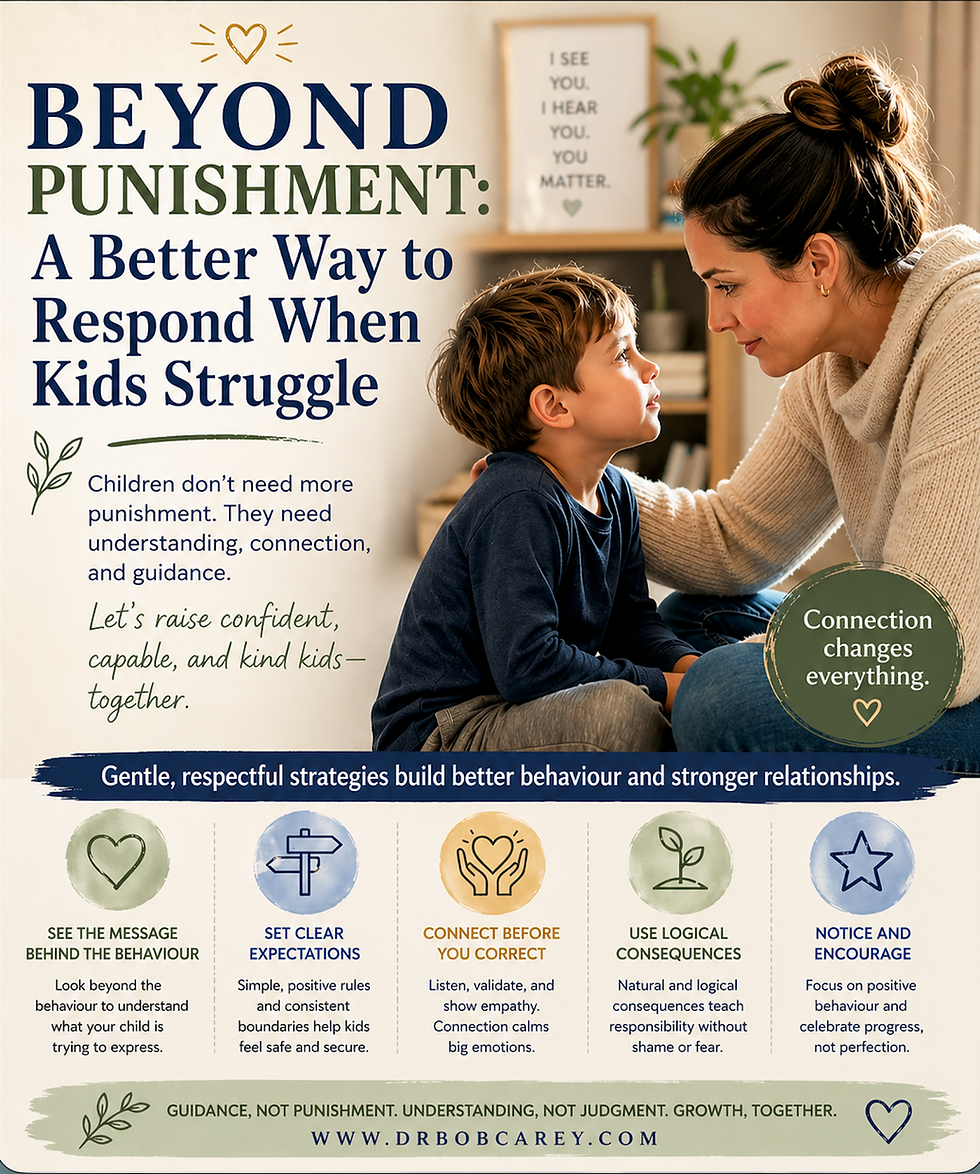
When a child’s behaviour suddenly escalates, it can feel like everything shifts in an instant. One moment things are calm, and the next you’re dealing with noise, frustration, and a growing sense of urgency to make it stop. In those moments, it’s completely understandable that many parents reach for quick solutions—often in the form of punishment. But over time, what becomes clearer—both in research and in practice—is that there is a more effective and more respectful way to guide children through those difficult moments.
What I often share with parents is that behaviour is not something to simply control—it’s something to understand. When we shift our mindset in that direction, everything begins to change. Instead of asking, “How do I stop this?” we begin asking, “What is my child trying to communicate?” That question alone opens the door to a very different kind of response—one rooted in connection rather than correction.
Children don’t act out in a vacuum. Their behaviour is often an expression of something happening underneath the surface—frustration, overwhelm, confusion, or an unmet need. A tantrum, for example, isn’t just “bad behaviour.” It’s often a child’s way of saying, “I don’t know how to handle what I’m feeling right now.” When we respond with punishment, we may stop the behaviour in the moment, but we miss the opportunity to help the child build the skills they actually need.
A more helpful approach is to think of guiding behaviour the way you might tend to a garden. If something isn’t growing well, we don’t punish the plant—we look at the conditions. Does it need more light? Better soil? More consistent care? Children are no different. When we focus on nurturing the conditions that support positive behaviour—clear expectations, emotional safety, and consistent connection—we begin to see more meaningful and lasting change.
Part of this involves being intentional about how we set boundaries. Children do need structure—it helps them feel safe—but the way we communicate those expectations matters. When expectations are clear, simple, and framed in a positive way, children are much more likely to understand and follow them. It reduces confusion and, in turn, reduces frustration for everyone involved.
Equally important is how we respond when things don’t go as planned. Rather than relying on punishment, it can be far more effective to allow children to experience the natural or logical outcomes of their choices—when it’s safe to do so. These kinds of consequences are directly connected to the behaviour, and they help children learn responsibility without the added layer of shame or fear. Over time, this supports the development of internal regulation rather than dependence on external control.
Another shift that makes a significant difference is slowing things down in emotionally charged moments. When a child is upset, our instinct is often to correct or fix the behaviour immediately. But what children need first is to feel understood. Taking a moment to listen, reflect, and validate their experience helps to de-escalate the situation. It sends a powerful message: “I see you, and I’m here with you.” From that place of connection, children are much more open to guidance.
You’ll also notice that many behavioural struggles are really about control. Children, like adults, want a sense of agency in their lives. When they feel powerless, behaviour can quickly become oppositional. Offering small, structured choices can go a long way in reducing those power struggles. It gives children a sense of ownership while still keeping you within clear and appropriate boundaries.
Of course, none of this works in isolation from how we, as adults, show up in those moments. Children are constantly learning from what they observe. When we are able to remain calm, even when things feel challenging, we are modelling the very skills we want them to develop. That doesn’t mean we get it right all the time—but it does mean being mindful of the tone, language, and energy we bring into those interactions.
At the centre of all of this is connection. When children feel secure in their relationship with you—when they feel seen, heard, and valued—they are naturally more inclined to cooperate and engage in positive ways. Connection builds trust, and trust is what allows guidance to be received rather than resisted.
This is also why relying on punishment can be problematic over time. While it may produce short-term compliance, it often comes at a cost. It can create fear, erode trust, and shift the focus from learning to avoiding consequences. In some cases, it teaches children to hide mistakes rather than work through them. That’s not the kind of skill set we want them carrying forward.
When we take a more supportive and non-punitive approach, we begin to see different outcomes. Children start to develop the ability to manage their emotions, to problem-solve, and to make better choices—not because they are afraid of what will happen if they don’t, but because they understand and feel supported in doing so. This aligns closely with a Positive Systems Approach, where the focus is on creating the conditions that allow positive behaviour to emerge, rather than trying to control behaviour after the fact.
You’ll also find that what we choose to focus on matters a great deal. When we consistently notice and acknowledge positive efforts—whether it’s sharing, trying something difficult, or showing kindness—we reinforce those behaviours in a meaningful way. It doesn’t require anything elaborate. Often, it’s simply about being specific and genuine in what you notice.
For many parents, shifting away from punishment can feel unfamiliar at first. It requires patience and, at times, rethinking the way we were taught to respond as children ourselves. That’s a process, and it’s okay for it to take time. What matters is the direction you’re moving in. Even small changes in how you respond can have a meaningful impact on your relationship with your child.
What I often encourage parents to remember is this: you’re not just managing behaviour in the moment—you’re helping your child develop lifelong skills. Every interaction is an opportunity to teach emotional regulation, problem-solving, and resilience.
So the next time things feel like they’re escalating, pause for a moment. Instead of asking how to stop the behaviour as quickly as possible, consider what your child might need in that moment—and how you can guide them there with clarity and care. That shift, while simple, can be incredibly powerful in shaping both your child’s development and your relationship with them.


Comments